• About
  • Working Together
  • UK-MADE MENSWEAR
  • Style
    • Menswear
    • Accessories
    • Grooming
    • Style Inspiration
    • British Made
    • Collaborations
  • Lifestyle
    • Travel
    • Cars
    • Watches
    • Food & Drink
    • Arts
    • Events
  • People

XO Grey Fox

Showing posts from category: Made in Scotland

Harris Tweed: A Journey to the Heart of the Hebrides

Tuesday, 3 October 2017

Looking into a piece of Harris tweed with a magnifying glass is like chasing down a fractal: you never quite seem to reach the end of the colours and textures in its depths. The cloth reflects its origins on Scotland's beautiful but exposed western Atlantic fringes. From the vast peaty moors of Lewis to the beautiful beaches, mountains and inlets of Harris, the Outer Hebrides are so interwoven with the tweeds they produce that its hard to appreciate the one without the other.

The white beaches of Harris

Harris tweed colours

Earlier this year I was privileged to be a guest of The Harris Tweed Authority on a journey to discover this most wonderful of tweeds. I knew, of course, that the cloth is woven in the homes of islanders, but the details of its story had escaped me. I gave a visual tour of its production on my Instagram account at the time and reproduce a few images here. 

To be a true Harris tweed, stamped with the Harris Tweed Authority seal of approval, the Orb, various legal requirements have to be met; in particular the need for it to be woven at home in Harris and Lewis, rather than in a mill. It's a product of a close partnership between three mills and a group of individual weavers who produce the cloths which are so appreciated around the world.

I visited one of the mills that prepare and dye the wool (Harris Tweed Hebrides in Shawbost; see images below), spin it into yarn which is warped onto beams which are sent out to the weavers for the cloth to be woven. The weaver adds the weft to the warp and returns the cloth to the mill to be finally washed and checked, stamped with the Orb and distributed. This isn’t a mass-produced product, it’s a home-made cloth that contains the essence of the islands in which it’s made. The depth of colour results from the wool being dyed before spinning, rather than the yarn being dyed after it's been spun. The process is illustrated below:

Dying the wool


Blending colours to make the tweed required


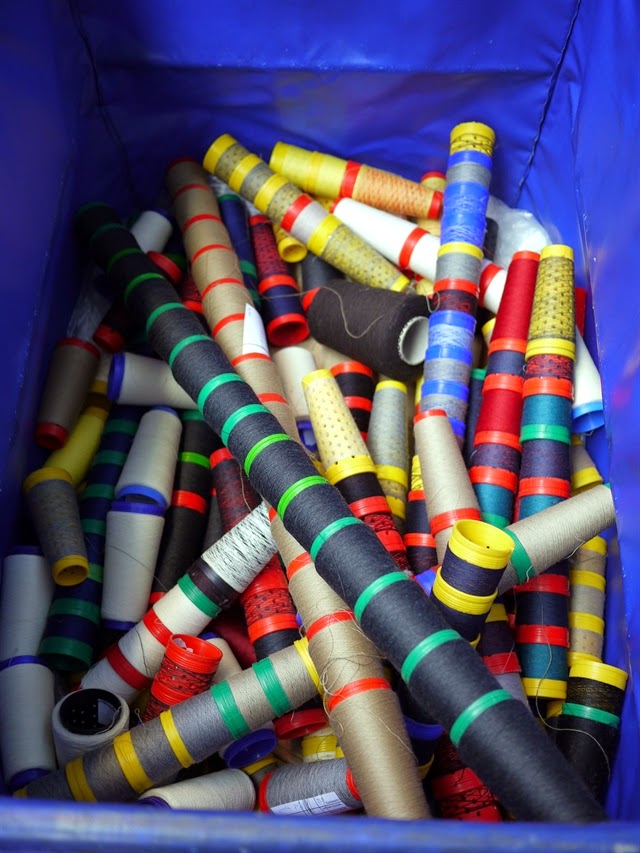
Spinning the yarn

Warping the yarn onto a beam to be sent to the weavers to complete the cloth in their homes

Once back from the weavers the cloth is carefully finished (washed to make it softer), checked for defects and has the famous Orb applied before being packed and despatched all over the world.

The weavers return the woven cloth to the mill for finishing and checking

Checking the cloth to ensure it's perfect

The orb is applied - I was given a length of this very cloth

I also visited some of the weavers in their homes (below). Most work in weaving sheds next to their houses on modern looms that weave full width cloth. Some still use older Hattersley looms, which produce half width cloth. Some carry out the whole process, from warping to weaving, rather than relying on a mill to deliver the warped beams. These few produce limited runs of unique cloth that are much sought after. 

At present the future of Harris tweed and the craft of weaving looks secure; but it would be more so if we all appreciated the value of this product and went out of our way to support it by buying Harris tweed off-the-peg clothing, furnishings and accessories or by asking our tailors for it by name

Weaving the cloth

A Hattersley loom

Donald John McKay MBE, with his Hattersley loom (top) and his own tweeds, used by tailors such as Brita Hirsch

I was pleased to be given a length of Harris tweed during my visit to Shawbost. I'm collaborating with bespoke tailor Brita Hirsch to make this into a jacket showpiecing the best of tailoring and the best of Scottish tweed; but that's another story: keep an eye on my Instagram account and on here for more.

I'm grateful to Leica UK for lending me a Leica Q for the trip. I'm no photographer, but the quality of the images it captured, often in dark weaving sheds, was quite outstanding. The top two and final three images here are taken with the Leica Q, the remainder with my Fuji X100S.

I'm very grateful indeed to the Harris Tweed Authority, whose guest I was. I received no payment. All views are my own.

Links:
Harris Tweed Authority - here you can find out more about how the tweed is made
Harris Tweed Hebrides
Leica Q
Brita Hirsch Tailor

Books:
Harris Tweed; From Land to Street by Lara Platman - a photographer looks at everyone involved in making the cloth.
From The Land Comes the Cloth by Ian Lawson - a sumptuous photographic record.
Share:
7 comments
Labels: Harris Tweed, Made in Scotland, Made in the UK, Tweed

Fraser Knitwear scarves: made in Shetland - a Grey Fox photoshoot

Tuesday, 8 December 2015

No matter how good your coat and hat, you're always going to feel the cold without a good scarf. Fraser scarves are made in the Shetland Isles, the home of Fair Isle knitting. The islands' position to the far north of the Scottish mainland has for centuries put them at the centre of trading routes with Scandinavia and the Baltic, leaving cultural influences including the rich patterns of Fair Isle knitwear. 

We're lucky, living in our ancient, multicultural country here in the UK, to be able to raid a rich seam of historic clothing design and wear tweeds, tartans, knitwear adapting it from its original uses to wear in town or country, for formal or informal. For our photo shoot, Joan Fraser asked us to portray her beautiful scarves in an urban setting. 


Made from lambswool or cashmere, the scarves come in a very natural range of colours from monochromes, soft blues, through dove greys and stone to chocolate brown. Contemporary and understated, they've rapidly become my favourites: the lengths are ideal, they are soft, warm and comfortable and bring a subtle mix of contemporary and historic design to enhance any casual or formal look. With their Fair Isle designs they also make excellent Christmas presents. See Fraser Knitwear for more information and to buy. Prices from £60 to £110.

Photographer Nick Maroudias. Styling by personal stylist, Sarah Gilfillan of SartoriaLab. This photoshoot was sponsored by Fraser Knitwear.

Suit: Edit Suits
Tweed coat: Greatcoat
Tweed jacket: Gloverall


Share:
1 comment
Labels: knitwear, Made in Scotland, scarves

Friday Favourites: Johnstons of Elgin knitwear for spring & Bedroom Athletics slippers

Thursday, 9 April 2015

Johnstons of Elgin

From Johnstons of Elgin comes Scottish high quality knitwear and these two jumpers are ideal for those chiller days on spring and summer.


On the left: a slim-fit round-neck jacquard jumper, £195. On the right: cashmere cable-knit round-neck jumper, £245. From Johnstons of Elgin.

Bedroom Athletics

From the wonderfully (and promisingly) named Bedroom Athletics comes a range of loungewear and slippers. They offered me a pair of their men's Harris Tweed moccasins. Made in a variety of patterns and colours of the Scottish tweed which is hand-woven on Harris, they are comfortable and stylish; not at all 'fluffy-slipperish', if you know what I mean. For the man who likes his slippers to have a dash of testosterone. £60 from Bedroom Athletics.

Bedroom Athletic Edward - Harris Tweed moccasin slippers (dog hairs extra)


Share:
No comments
Labels: Bedroom Athletics, driving shoes, Johnstons of Elgin, knitwear, lounge wear, Made in Scotland, moccasins

Catherine Aitken - Harris tweed bags and accessories made in Scotland

Saturday, 31 January 2015

Catherine Aitken's studio is in Leith, Edinburgh, where she creates bags, scarves and other accessories for both men and women from Harris tweed and other high quality materials. Catherine sent some of her products for me to have a look at. All are beautifully-made. 

I love bags made from tweed. As a material, it's strong, comfortable and the colours go with anything. The duffel bag is robust, comfortable to use and well-designed.


For more information and to buy, visit Catherine Aitken's website and blog. To see her collection of men's bags and scarves, visit here.


Share:
1 comment
Labels: bags, Catherine Aitken, duffel bags, Harris Tweed, Made in Scotland, Made in the UK

Country of Origin: knitwear hand-framed in Scotland

Tuesday, 20 January 2015

I had the opportunity to try some beautiful knitwear hand-framed in Scotland recently when the good people from Country of Origin asked me to take part in a photo-shoot. 


The jumpers have to be worn and felt to be truly appreciated; the lambswool is thick and soft, very luxurious and warm. They are made to order on a vintage hand-powered Dubied knitting machine that adds character and individuality to each limited-edition piece. 

No mass-produced jumpers here. Go to Country of Origin for more information and to buy.

Harry's tweed collar and lead are from LoveMyDog.


Share:
3 comments
Labels: Country of Origin, Dubied knitting machine, hand framed, knitwear, Made in Scotland, wool, wool production process

Johnstons of Elgin: the best of British manufacture since 1797

Tuesday, 7 October 2014

After visiting Johnstons of Elgin I came away fired up with the creativity and skills that go to make British manufacture. We're not good at appreciating the treasures made here in the UK, but if consumers had the opportunity to visit a factory like that in Elgin, they'd be buying British tomorrow.

Johnstons of Elgin - the site of their original factory from 1797 - all images Grey Fox

For over 200 years Johnstons have been weaving wool on the banks of the River Lossie in Elgin, making a variety of products, from cashmere and vicuña scarves to beautiful estate tweeds. Their knitwear is made much further south, in Hawick in the borders.

The wool store

Tucked away about seventy five minutes drive north west of Aberdeen, Elgin is in an area of Scotland that benefits from clean water, flowing rivers and soft lowland scenery. The features that brought mills to the area (water to clean wool and to power looms) also brought the great Speyside whisky distilleries; but unfortunately there wasn't time to visit both.

Dying the wool

The factory is a fascinating mix of tradition and technology as the wool is prepared from raw material to finished cloth. Many of the looms and carding and spinning machines contain parts that would have been recognisable in Victorian times, yet they work away alongside those using laser technology. Teasels are still used in the cashmere-weaving process to achieve a soft finish. Here it's a question of recognising what works and not changing for change's sake.

Spinning

Two parts of the visit stood out for me. Firstly, speaking to the design staff brought it home to me what high esteem Johnstons is held in internationally by the world of high fashion. Household names come to Johnstons to collaborate and to take advantage of their outstanding manufacturing and design skills.

Menswear from Johnstons of Elgin

Johnstons are understandably quiet about their contacts and collaborations, but their recent work with Burberry is a matter of public record and their involvement in developing the monogrammed poncho that rocked the catwalks for AW14 is well-known. To see British design and manufacture having such status on the world stage is gratifying to say the least

Weaving tweed

The second highlight for me was their archive. A room full of beautifully-bound books containing samples of tweeds and woollen fabrics from the nineteenth century. There to provide inspiration to modern designers, the collection is breathtaking in its range. I'd love to get in there and design a range of Grey Fox tweeds.


The factory shop is full of their products, tweeds, knits and home wear, gorgeous rugs and cushions. The tea shop rounds off a fascinating visit and leaves me full not only of cake, but of hope for the future of British manufacturing.

See Johnstons of Elgin for more information or to buy.

The people, without whom the looms would be silent

The archive

Nineteenth century tweeds in the archive


Share:
No comments
Labels: Campaign for Wool, Johnstons of Elgin, knitwear, Made in Britain, Made in Scotland, Made in the UK, Tweed, wool, Wool Week

It's #BuyBritishDay but are fashion consumers really interested in where their clothes are made?

Friday, 3 October 2014

How important is a Made in Britain label to consumers?

If you’re reading this it’s likely you have an interest in British-made goods. Whether you’re a designer, manufacturer, retailer or blogger you will hold a Made in Britain label in high esteem. But is your enthusiasm matched by the British consumer?


There was recently some discussion about this on Twitter – the subject was British-made fashions. How much, someone asked, do high street buyers really care about where the clothes they buy are made?

Mintel, the global market research company, came to the rescue with some information, and it seems that the attitude of consumers may not yet be quite what we would hope for:

- 33% of Brits rate clothes made in Britain as an important factor. This rises to 36% of women, compared to 31% of men. 

- Brits rate durability of clothes as the most important at 88%, with quality of the product finish at 87%. 

- 44% of Brits rate Ethical treatment of workers who make/ manufacture clothing as an important factor and 30% think the retailer being environmentally friendly is important. 

Tweed manufacture at Johnsons of Elgin in Scotland - image Grey Fox

Mintel’s Senior Consumer Analyst, Tamara Sender, added the following comments on Britsh Fashion.
"A third of clothes buyers see clothes made in Britain as an important factor that influences clothes shopping. Interest in locally made clothes peaks among women and older consumers aged 55 and over. Despite this, most consumers still place this relatively low in their priorities with other factors such as quality, low price and latest fashion all taking precedence. 
In the wake of the horsemeat scandal, the importance of buying British food and special attention to the origins of products has been reinforced. There is therefore scope for the fashion industry to promote clothing Made in Britain and to push for some manufacturing to be bought back to the UK. 
There has already been growing interest among retailers in producing some of their garments in the UK to deal with issues of short lead times as consumers demand more regularly updated collections. A clothing manufacturer that supplies retailers including George at Asda, Matalan and Primark opened a factory in Leicester in May 2013, which will allow it to make some of their items in the UK. The heritage revival is also seeing Made in Britain become an important strategy for major UK retailers such as M&S and John Lewis. 
Mintel’s consumer research shows that there is most interest in both clothes Made in Britain and frequently updated clothes from high spenders, meaning there is scope for more retailers to sell limited-edition ranges of locally made clothes at a premium to their regular brands. Retailers including M&S, Asos and Jaeger are already experimenting with this and we expect this to become a growing trend. It is likely that even mid-spenders, who show above-average interest in new collections, and are increasingly mixing and matching more expensive clothes with cheaper clothes, may be willing to splash out on something special and with a link to the UK."

How to get across to and engage with the consumer - Grey Fox's thoughts

It seems to me that you need to keep telling the stories about your brands, emphasise quality, sustainability and ethics of local production (without preaching!) Add to your blogs and websites information and profiles on the skills required, individual workers, the machinery you use - all will help engage the buying public. 

Use social media and bloggers. Without social media you're dead in the water. Bloggers are friendly, good value and, if well-chosen, enthusiastic about British-made products.

See Mintel


Share:
3 comments
Labels: British made, Made in Scotland, Made in the UK, Mintel

A Scottish celebration: Future Legend - Ten30 tweed and Dauvit Alexander

Saturday, 20 September 2014

As an Anglo-Welshman, the thought of losing our Scottish friends and neighbours in the recent independence vote had filled me with horror. I therefore wanted to mark the outcome of the referendum, and the preservation of the United Kingdom, with a Scottish special.

I'm grateful to Alan Moore of ten30 and Dauvit Alexander, jeweller, aka the Justified Sinner, who have collaborated on this photographic project celebrating tweed, jewellery and Scottish creativity. They rushed these images to me to help me mark this momentous occasion.

All images Simon Murphy, 2013

Alan told me about the project:

"My name is Alan Moore, I am a Glasgow School of Art graduate and I started my own label, ten30, in 2011. In the beginning the focus was on womanswear, using a lot of digital printed silks and embroidery on simple shapes. The brand was quite conceptual and I did a lot of exhibitions, films and photography as well as artist collaboration. The womenswear days were a lot of fun and very expressive as a designer, but ultimately, not working as a business. 


My ethos has always to produce garments in Scotland, using raw materials sourced from the UK. This caught the attention of Harris Tweed Hebrides, one of the biggest producers of the cloth, and they approached me with a commission proposal. The idea was to produce a small collection of men's jackets, 100% made in Scotland with a strong concept of heritage and story behind them. This is the kind of brief I relish and I got really into it. I was given three tartans to work with, a burnt orange and grey check, a modern Mackenzie hunting-look tartan and a white Stewart look tartan. 


My initial idea was to look at the cloth and develop a concept and story around that, then a garment would come naturally. With the orange cloth, it instantly reminded me of smoked salmon (a very strange correlation, but it was the first thing into my head and I usually trust my first instinct) I ran with the fishing theme and thought it went well with the cloth, the heritage of the Scottish fishing industry and the fact that it's still relevant today. So around this concept I designed a double breasted peacoat, complete with a thick quilt lining and waxed cotton collar and pockets, making the jacket as practical as it as aesthetical.


The Mackenzie tartan reminded me of the Scottish landscape, for me it was a real example of Scottishness. From this I looked into the history of Scottish kings and Nobles. Although he had a colourful and controversial history, the story of Robert the Bruce picking himself up after defeat after defeat at the hands of the English was inspiring to me. I called the single breasted 2 button, The Bruce. It has leather detailing on the pockets and is a traditional square cut jacket. The final jacket was the white Stewart tartan. This cloth was multicoloured, slightly garish and almost arrogant. I had to find a concept or character that would fit into the cloth, and who could pull it off. 


With the Stewart connection, I looked to racing driver Jackie Stewart as my inspiration. A double breasted, peaked lapel 4 button seemed to fit the bill, as the wearer would need to have a bit of confidence about him to pull it off.


The jackets were photographed by Simon Murphy, one of the best photographers in Scotland at the moment, and published on the front cover of the Scotland on Sunday magazine. Since then people started to ask about buying the jackets and asking for more options in menswear. The womenswear came to an end round about January this year when I decided I no longer loved that part of the industry. The label has been gaining strength and popularity since then and I have grand plans for the future".

See ten30 and Dauvit Alexander for more information, or to buy.


Made in Scotland

Share:
No comments
Labels: Dauvit Alexander, Harris Tweed, Made in Scotland, Made in the UK, Scotland, ten30, The Justified Sinner, Tweed

Quiggleys and Bowmont Devon cashmere collaboration

Tuesday, 9 September 2014

I was touched to receive this e-mail this week from Chris of Quiggleys (whose made in Scotland knitwear has appeared before on Grey Fox):
"Hello David
Well I thought you might be interested in this as you are 100% responsible for it. 

Following my visit to Lesley [of Bowmont and Devon Fine Fibres] and her amazing goats you might remember you Tweeted asking what we were planning together. I replied we were going to make a hat which, as I typed, it made me realise that, of all the things we could do with this amazing yarn, a hat was hardly the most exciting. 
So thanks to your Tweet, we've made a jumper (as well as the hat) and here it is. This is just the first sample (sleeves need a bit of attention) and it’s only me, photographed by me in my back garden, but I thought you’d like to see what you had an accidental hand in. 
I'm heading to Ardnamurchan (as in Ardnamurchan Point on the shipping forecast) to shoot all the new styles for this Autumn, so will hopefully have some slightly more interesting photos of this soon and all the new styles on the website in 2-3 week time.
So thanks for your input and I hope you like it. 
Chris.
PS: It is softest best cashmere ever".
I will update you on this exciting collaboration when I have some more images. 

Meanwhile visit Quiggleys website to see their beautiful British-made knitwear and see Bowmont and Devon Fine Fibres for more information on her remarkable cashmere goats and merino sheep.

Click here for previous articles on Quiggleys on Grey Fox Blog.


Share:
2 comments
Labels: cashmere, Devon Fine Fibres, knitwear, Made in Scotland, Quiggleys, sweater

Trakke - video introducing the Scottish manufacturer of outstanding adventure bags

Thursday, 26 June 2014

TRAKKE makes truly outstanding adventure bags in Scotland. I'll be writing about them soon, but wanted to introduce them to you with this video. I am a great believer in the power of a story to make a product interesting and here Alec Farmer, Trakke's founder, tells something of his brand's story.

Trakke. Adventure Everywhere. Handmade in Scotland

For more information, see Trakke's website.
Share:
No comments
Labels: adventure, bags, Made in Scotland, Made in the UK, Trakke

Quiggleys - good simple lambswool crew neck jumpers

Tuesday, 13 May 2014

What better than a simple lambswool crew neck jumper like these from Quiggleys? Ideal as warmer weather sets in. Keep it in the bag or draped artfully around the shoulders for chilly moments.

The Clunie

Called The Clunie, these are knitted in Scotland from Scottish yarn. I've featured Quiggleys before because I love their classically simple approach to traditional menswear. Below is an image of Claire, one of the knitters used by Quiggleys - demonstrating that these jumpers aren't the result of machined mass-production. See more information on the Clunie range in their look book here.

Available from Quiggleys here.


Share:
No comments
Labels: knitwear, Made in Scotland, Quiggleys
Home
Older Posts
Subscribe to: Posts (Atom)

About

About
Older blogger (63) in search of style. Menswear & lifestyle writer.
Learn more...

Follow

Popular Posts

  • The Grey Fox Shop re-opens - my favourite products chosen for you
    Some hard work has brought the re-opening of the Grey Fox Shop , giving me the chance to offer blog readers a constantly-changing selection ...
  • Denim jeans and the middle-aged and older man
    Sooner or later the middle-aged man in search of style will have to establish his position in the blue denim jeans and the older man debate....
  • Where are all the blogs about fashion and the older man?
    Before starting this blog I searched for what I assumed would be scores of blogs with an interest in men's fashion and style in middle a...

Categories

  • lifestyle
  • people
  • style

Search This Blog

Powered by Blogger.
© XO Grey Fox · Theme by xomisse